


In this post, I share information and tips to help you schedule your small group instruction and fit it all into your busy day! I offer you a FREE small group planning template and leave you with details about my Leaders of Literacy membership where all of the planning and prepping for small group instruction has been done for you!
Lately, I’ve been hearing a lot from teachers who understand the benefits of small group instruction but, for a variety of reasons, struggle to make it happen in their classroom. Maybe they don’t know what to teach or don’t have access to SoR-aligned resources. Maybe they are overwhelmed by the amount of time it takes to plan for all their small groups, or feel they simply don’t have time to fit it into their day. I understand these challenges and know they are very real.

The good news is I have information and resources that can help alleviate these struggles. Recently, I shared information on what skills to teach in small group instruction and shared SoR-aligned, low-prep resources to help you teach those skills. In my last post, I shared tips to you help plan for small group instruction more efficiently.
Today I am excited to share information and tips to help you schedule your small group instruction and fit it all into your busy day! I’ll offer you a FREE small group planning template and leave you with details about my Leaders of Literacy membership where all of the planning and prepping for small group instruction has been done for you!
How Much Time Should I Spend on Literacy Instruction?
Research shows that ALL students need at least 90 minutes of uninterrupted reading instruction each day to become strong readers.
Those 90 minutes are used to provide students with explicit and systematic instruction and practice with the following skills:
- Oral language
- Phonemic awareness
- Phonics
- Fluency
- Vocabulary
- Comprehension
How Much Time Should I Spend on Small Group Instruction?
To provide instruction on all of these skills, I recommend splitting up your 90-minute block into three separate parts. My preference is to start with a 20-minute block of whole-group word recognition instruction. Then move on to a 50-minute block of small group instruction. Wrap the literacy block up with another 20-minute block of whole-group language comprehension instruction. Of course, you can tweak those minutes based on the needs of your students, your schedule, or the requirements of your school.

Ideally, in a K-2 classroom, a small group session should only last 10-15 minutes. Any longer than that and students will begin to lose focus. Keeping it short and concise ensures you can see at least 3 groups a day.
How Many Times a Week Should I See Students in Small Groups?
If you have 4-6 small groups, you simply cannot see every group every day. That is okay! Students who fall below tier 1 instruction DO need to be seen every day. Students who are performing on grade level should be seen 3-4 times a week. Plan to see students who are above grade level 1-2 times a week.

Small Group Planning Template
To help you map out your week, I am happy to offer you this FREE editable small group planning template. It offers you information on the high-impact instructional routines you will use / skills you will teach and allows you to look at the entire week in one glance.
Please note, that you do NOT need to teach each skill every day. You simply do not have enough time to do that! Instead, try to incorporate them throughout the week.

Drop your email below to instantly download these editable small-group planning templates
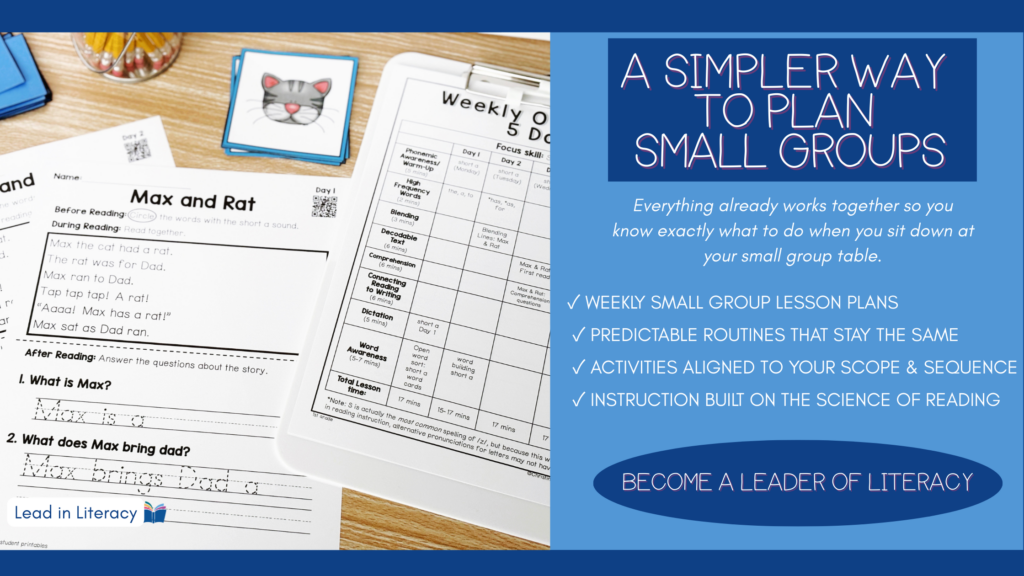
A Simpler Way to Plan and Teach Your Small Groups
Your small group instruction doesn’t have to feel complicated or pieced together. With clear routines, aligned materials, and intentional, data-driven planning, it can become one of the most powerful parts of your day.
Leaders of Literacy puts pieces of small group instruction in place for you.
When you’re a Leader of Literacy, the plans are written, and the materials are ready. The instructional decisions have been made for you. Everything works together so you can provide targeted, differentiated instruction without having to start from scratch each week.
Become a Leader of Literacy and experience what it feels like to teach small groups with clarity and confidence.
.
.I ho